

The guarantee
No call returns the value of a field. Once any real value has been substituted in a session, every call that returns page-chosen content closes for the rest of that session, with two constrained exceptions below, and selectors may point at elements but not test what they contain. Two exceptions remain, and both are bounded:- Digit-free text selectors. A selector may still test page text, or an
attribute such as
aria-label, for any text without a digit in it: letters, punctuation and symbols. A match count or a wait is one bit of answer. The rule does not depend on which value the page is echoing, so the non-digit characters of any value the page echoes there can be recovered one character at a time: a name, an email address, a street address, or a password if a site renders a filled password as text. A value with no digits in it can be recovered whole. Digits cannot be tested this way, which keeps card numbers, security codes and one-time codes out of reach, along with the digits of any other value. Seecount()andwaitForSelector(). - Scrubbed
errorText.observe()returns the page’s own validation messages, written by the merchant, so an agent can tell why a form was rejected. Every value substituted in the session is removed first, and the list is withheld when the proxy cannot vouch for the scrub. Seeobserve().
How it works
A page can repeat a value the proxy just typed. It can print it as visible text, put it in an accessible name or a frame title, or leave it in an input. So the proxy treats the first token fill in a session as the point after which the page is no longer safe to read freely.The read surface, before and after
The practical rule for agents follows directly: orient before you fill. Look
at the product page, the cart and the empty checkout form first.
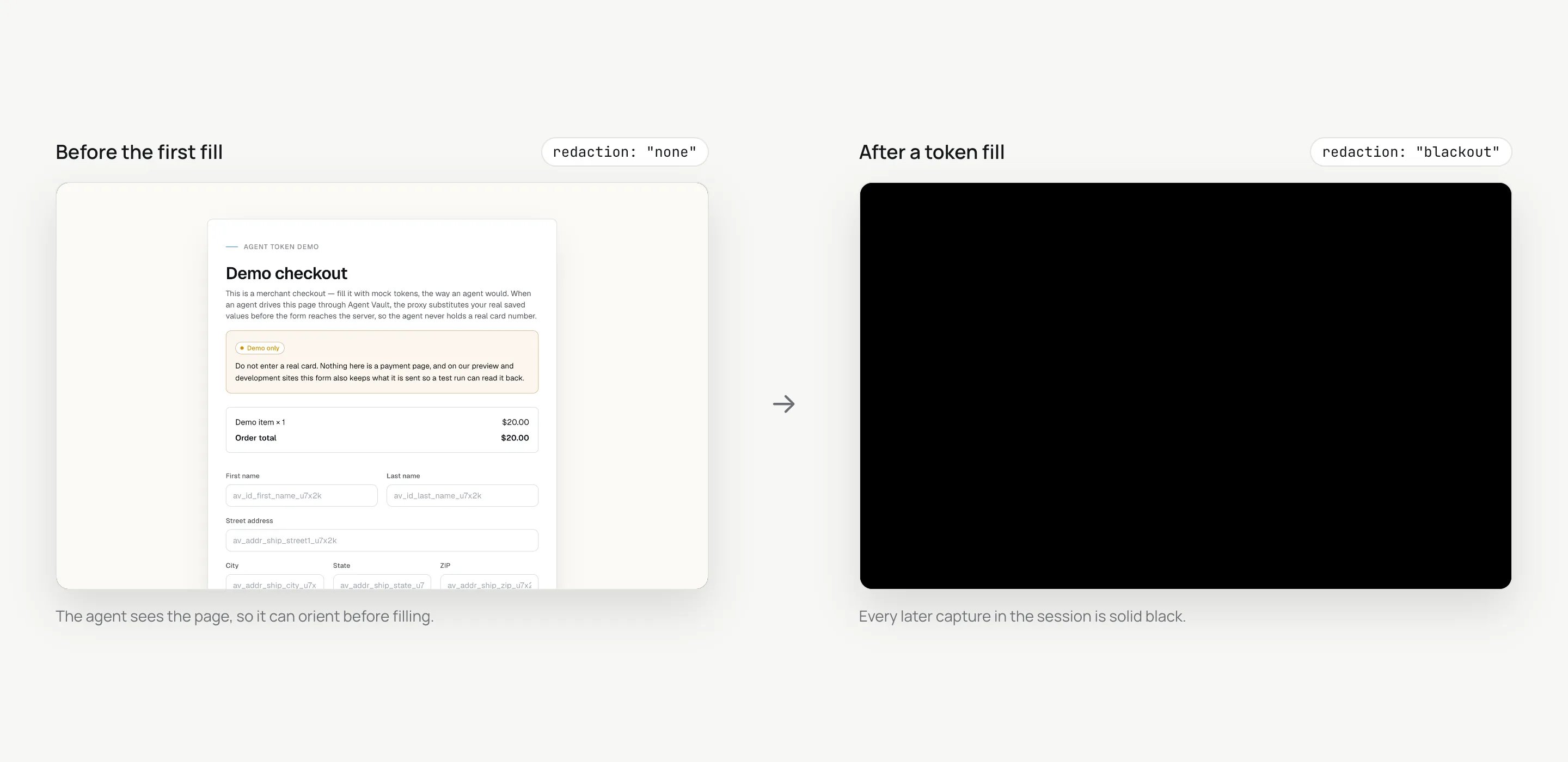
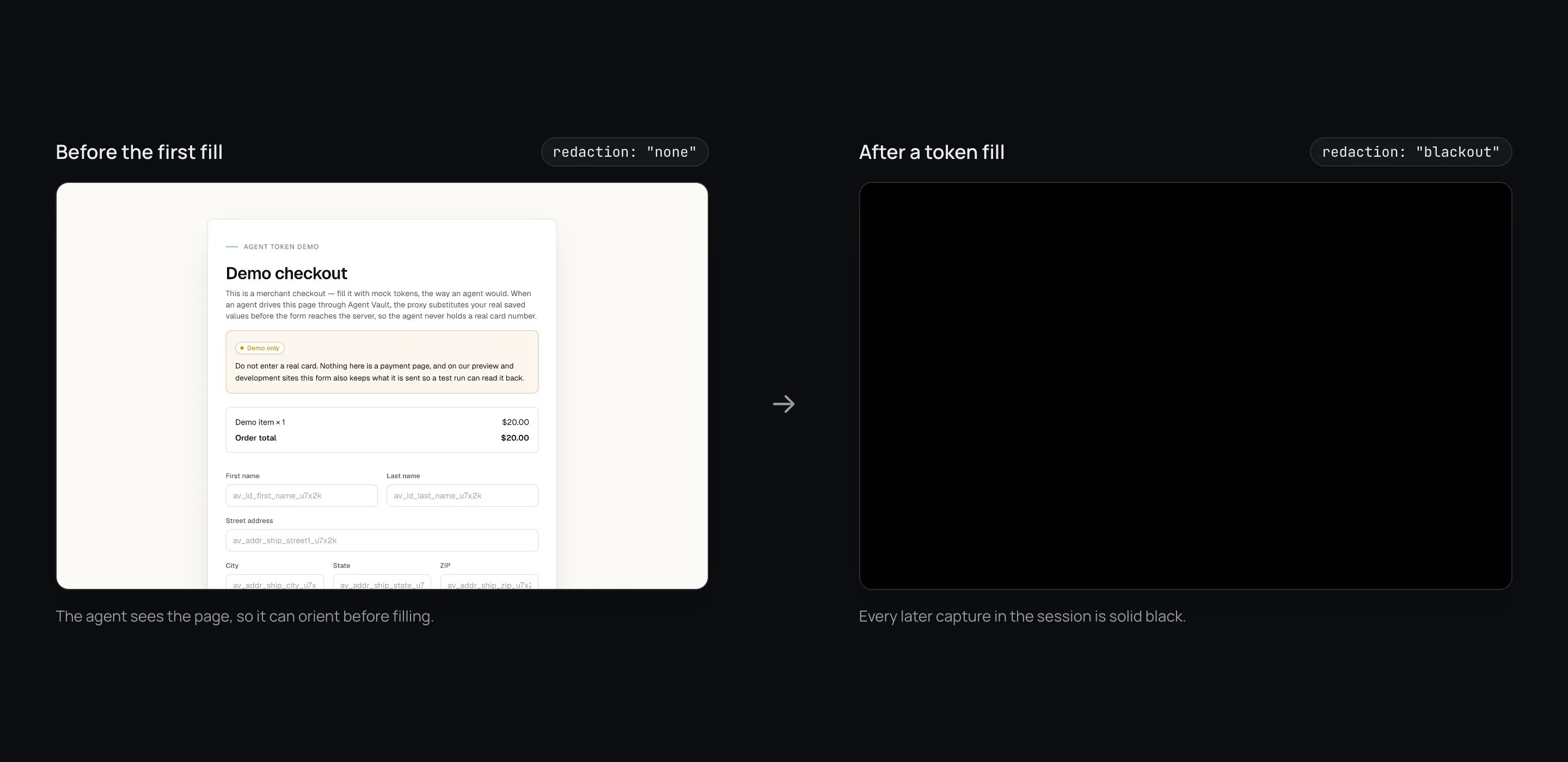
Before the first fill the agent sees the page; after it, screenshots are black.
Why each channel closes
Screenshots black out entirely, not per field
Screenshots black out entirely, not per field
A page can echo a filled value as visible text anywhere on itself, including on a
new document after a navigation, where boxing the original input covers nothing.
Scrubbing pixels selectively would require knowing where the value appears, and
with
evaluate() disabled the proxy cannot know. So the whole capture is
withheld. screenshot() still returns PNG bytes, with redaction: "blackout" and
a reason, so an agent can tell a blackout from a dark page. See
Screenshot redaction.The accessibility tree closes because names are page-chosen
The accessibility tree closes because names are page-chosen
A snapshot is built from accessible names, and the page chooses them. A page
holding a filled value could return it through one. Before the first fill the
tree is available, and the proxy strips every field value from it on every call:
you get the role, the name and a
[ref=eN] handle, never the contents.Frame listings close for the same reason
Frame listings close for the same reason
A frame’s name and URL are chosen by the page.
Clipboard chords close because they move text the agent cannot see
Clipboard chords close because they move text the agent cannot see
Copying a filled card field and pasting it somewhere the agent can read would
exfiltrate a value every read channel denies. The refusal covers the whole class
of modifier chords and fails closed on modifier names it does not recognise.
Plain keys still work.
evaluate() is always disabled
evaluate() is always disabled
Script in the page is a general-purpose read channel. Even before any fill, a
script could install a listener that captures a value the moment the proxy types
it, so no version of it is safe here. Every attempt returns
evaluate_disabled
and is logged.What remains, and why it is enough
observe()
A fixed set of questions the proxy answers itself, plus one scrubbed list of
validation messages.
errorText is the one field that carries page text, because an agent needs to
know why a form was rejected (“Enter a valid postcode”). It is read only from
elements the page declares as validation output (an [role='alert'] region, or
the message an aria-invalid field points to), never from a field’s value, and
it is limited to a few short strings. Before it leaves the proxy:
- Every value substituted in the session is removed, along with strings shaped like card numbers, email addresses, phone numbers and bearer tokens, even when the page has reformatted them.
- The whole list is withheld when the proxy cannot vouch for the scrub, for example after a challenge handoff, where the account holder typed something the proxy never saw.
display: none or visibility: hidden. A control
kept at opacity: 0 still reads as present.
detectChallenge()
A classification, never page text. See Handling challenges.
count() and waitForSelector()
You supply the selector, so the answer is a number or a wait, not content. This is
how an agent navigates a page whose screenshots are black:
sensitive_data_blocked any selector
that:
- Compares an attribute that holds a field’s value (
value,aria-valuetext,aria-valuenow,data-value). Testing that the attribute is present is fine. - Compares any other attribute that is not a plain pointer, such as an
aria-labelortitle, to a value with a digit in it. Pointer attributes such asid,class,nameandtypestay allowed. - Uses an engine that reads values or component props, such as XPath,
_react=or_vue=. - Puts a digit, or a regex escape that stands for one such as
\d, in a text match (:has-text(),:text(),text=, a role’s accessible name).
button:has-text("Place order"), text=/order (has been )?received/i. That
is the exception in the guarantee: the letters, punctuation
and symbols of any value a page echoes as text, or in an attribute such as
aria-label, can be probed one at a time.
Reading inconclusive
observe() and detectChallenge() set inconclusive: true when the scan did not
finish. Every false beside it then means unknown, not absent. A finished
scan omits the flag, so test for !result.inconclusive.
Fills go by CSS selector
Anaria-ref handle from a snapshot works for a count, a wait, a click or a key
press, but is refused for a fill. An in-frame ref reaches inside an iframe from
the top-level page, and filling that way would put a real value into a hosted card
frame without the frame’s own origin being checked. Fills use a CSS selector, and
frameLocator() for a payment iframe.
During and after a challenge handoff
While a handoff is open, every page call from the agent is rejected withchallenge_required. After a handoff, snapshots and errorText stay withheld
for the rest of the session.
What this does not protect against
- Screenshots after a handoff in a session with no token fill. These are not blacked out, and a page can echo what the account holder typed during the handoff. Agents are instructed to stop taking screenshots once a handoff has been granted, but a compromised agent may not comply.
- What the page shows before the first fill. Anything the merchant displays on its own, such as a saved address on a signed-in merchant account, is visible in a screenshot or snapshot taken before the first fill.
- Non-digit characters a page echoes as text. After a fill, a selector can test page text and non-pointer attributes for any text without a digit, including punctuation and symbols. A compromised agent can therefore recover the non-digit characters of any echoed value one character at a time, whatever token it came from. That covers a name, an email or a street address, and a password on a site that renders a filled password as text. A password with no digits can be recovered whole. Digits cannot be probed. The merchant receives these values in the clear anyway.
- Reformatted echoes in validation text.
errorTextscrubbing matches each substituted value as typed and common reformattings. A page that transforms a value beyond recognition is outside what a scrub can catch, which is why the list is withheld wherever the proxy cannot vouch for it. - Actions. Read restriction limits what the agent learns, not what it does. Clicks and submissions are bounded by URL locking and the spending controls, not by this page.
How to verify
Run this against your own account with a test card. It takes about five minutes.1
Take a reading before any fill
Open a session on a checkout page you can reach without buying anything. Call
screenshot() and snapshot(). Both return content, and the snapshot shows
no field values.2
Fill one token
Fill an address or card token from
get_token_catalog into a field on the
page.3
Read again
screenshot() now returns a black image with redaction: "blackout".
snapshot() and listFrames() fail with sensitive_data_blocked. A
Control+c chord fails with clipboard_blocked.4
Confirm there is no value channel
Call
observe(). It returns only the fields listed above. evaluate() fails
with evaluate_disabled at any point.5
Check the record
Call
get_run_report. It reports fills by kind
and count, never by value.Related
Screenshot redaction
Why the image goes black, and how receipts are handled.
Security model
Where read restriction sits in the overall design.