

In this page
- The premise. The AI agent is treated as untrusted. It never holds a working credential, only inert mock tokens.
- The mechanism. Agent Vault’s proxy, a browser that Agent Vault operates, substitutes the real value into the merchant page at the moment of the fill, under the account holder’s rules.
- The result. A compromised agent can, at most, make purchases the account holder’s limits already allow, at merchants they already allow, and attempts are recorded on a best-effort basis.
System overview
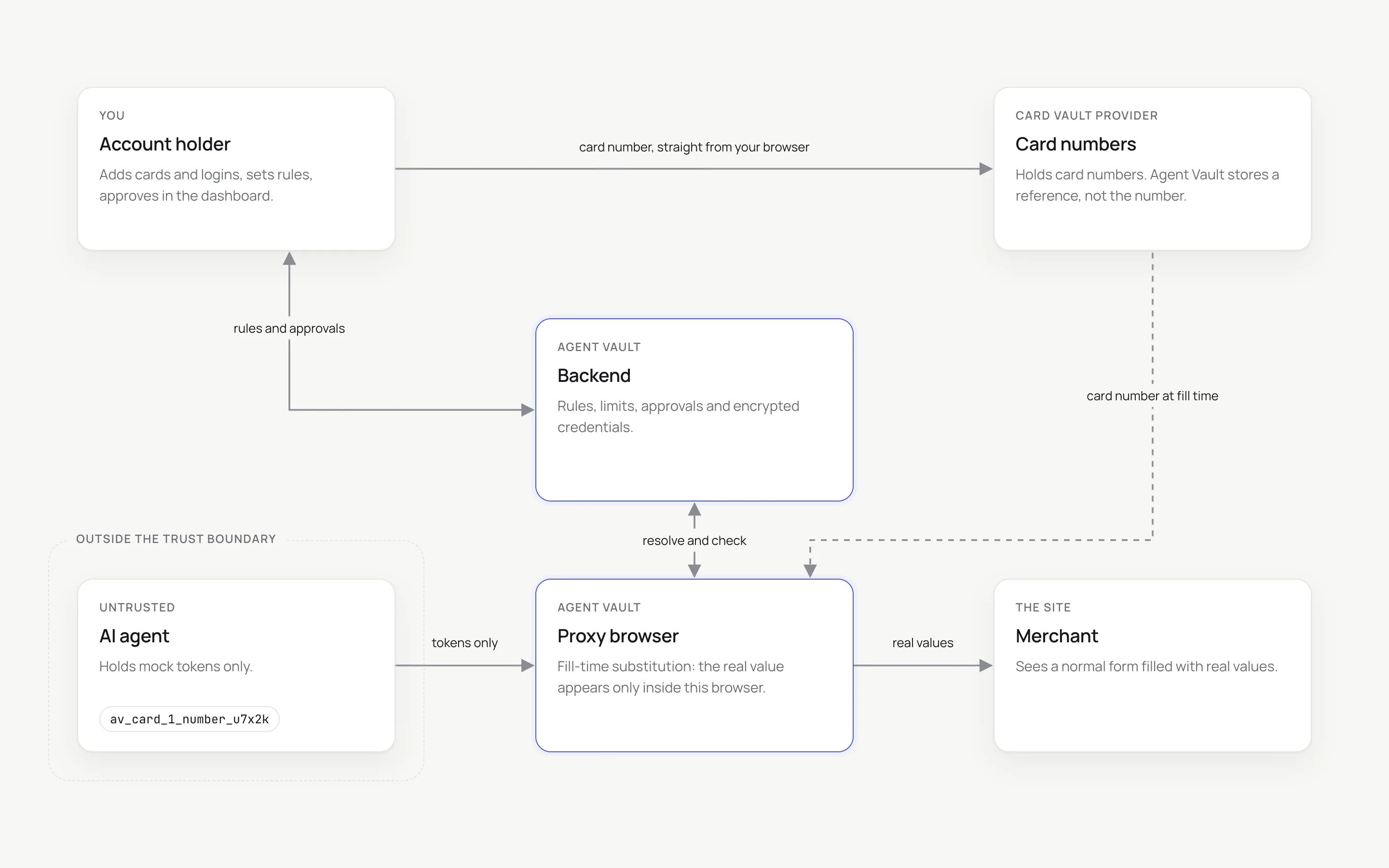
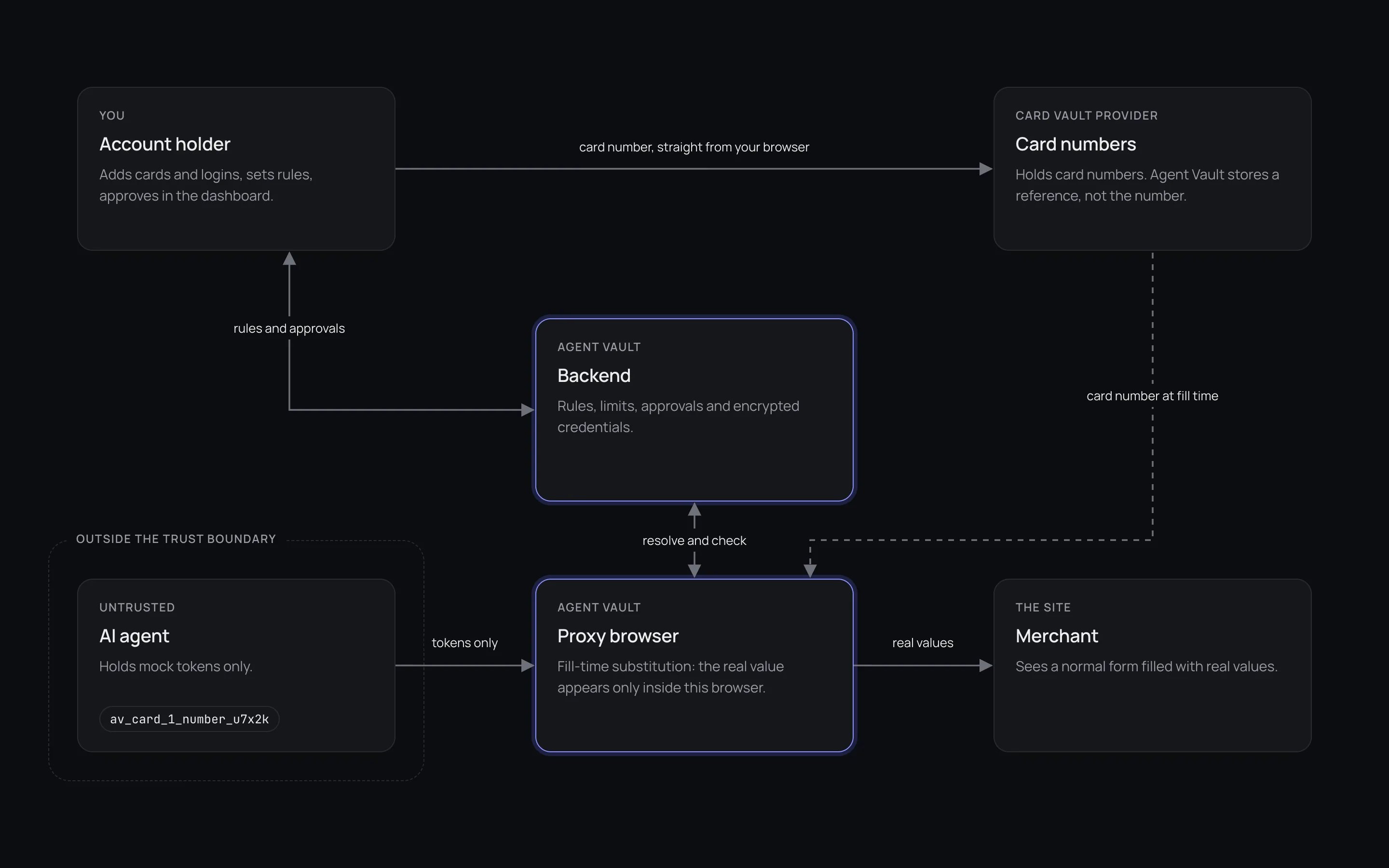
The components of Agent Vault and the trust boundary around the agent.
Assets
Who we defend against
A manipulated or compromised agent (primary)
A manipulated or compromised agent (primary)
An agent reads web pages, emails and tool output, and any of them can carry an
instruction. Prompt injection is part of the normal operating environment, so the
design assumes the agent will at some point follow an attacker’s instructions.
The question the design answers is what the attacker gains when it does.
A hostile web page
A hostile web page
A page the agent visits may imitate a real sign-in, try to receive a credential,
or try to read back a value the proxy typed, through visible text, accessible
names, frame titles or the clipboard. See
What the agent can see and
URL locking.
A leaked API key
A leaked API key
An API key is a bearer credential. A key that leaks gives its holder no more
than the agent it was issued to: the same scope, the same card rules and the
same audit trail.
Another Agent Vault account
Another Agent Vault account
Every token carries its account in its own grammar. A token from another account
is refused, and repeated attempts revoke the key that made them.
A network observer
A network observer
Real values are never typed into a plaintext
http:// page or frame on a
non-loopback host, or into a frame whose TLS status cannot be established. The
only plaintext pages allowed are loopback ones (localhost, 127.0.0.1 and the
like) used for local demos, whose bytes never leave the proxy’s machine. See
URL locking.If the agent is fully compromised
Assume an attacker controls the agent completely: its prompt, its tools and its API key.
Every token the attacker holds is checked again at the moment it is filled:
The worst case is therefore not “the attacker has your card”. For a card an
agent card governs, it is “the attacker can spend up to your per-transaction
cap on each fill, at a merchant you allowed, and the attempt normally appears in
your activity feed”. Repeated fills add up: the total is bounded only by the
daily, weekly or monthly caps you set and by your plan’s payment quota, so set a
rolling cap if you want an overall limit. The feed is best effort: a session event that fails to save is
dropped, not retried.
That bound holds only where a cap exists. Only your first card gets a starter
agent card, so every card you add after it starts ungoverned. A card no agent
card governs shows No limits on Cards. It has no spending caps and no
merchant rules, so an attacker holding a key that can use it can fill it for any
amount on any authorized destination, including a
checkout whose total cannot be read. The only count that still applies is the
plan’s payment quota: 5 or 100 payments in a rolling 30 days on Free or Plus,
then
plan_quota_reached. Enterprise has no payment quota, and preview,
development, test and staging deployments are not metered, so there it has no
bound at all.
Click Add limits on every such card. See
Cards.
Security properties
Fill-time substitution
Real values are revealed only to the proxy, only for an authorized fill, and
are never returned to the agent. The non-digit characters of a value a
merchant page echoes as text are the one exception.
URL locking
A login resolves only on the site it is registered for. A token filled on a
look-alike page is refused.
Least privilege
Each API key is scoped to specific cards and logins, and cannot create
credentials unless granted.
Bounded spending
Caps, merchant rules and an approval threshold are enforced at the fill, not
advised.
Read restriction
After any fill, screenshots go black and calls that return page content
close, except scrubbed validation messages. Selectors can test page text for
any non-digit characters, never for digits.
Audit without values
Sessions, fill kinds and refusals are recorded on a best-effort basis. No
substituted value is ever written down.
What depends on the account holder
Agent Vault bounds what an agent can do. The account holder sets those bounds and remains responsible for the following.1
Protect the dashboard account
Whoever signs in to the dashboard controls the vault. Use a strong, unique
sign-in and the strongest second factor your sign-in provider offers.
2
Issue one narrowly scoped key per agent
A key limited to the cards and logins one agent needs makes a revocation
surgical. See API keys.
3
Set limits that match the job
Per-transaction and period caps, merchant rules and an approval threshold
are the controls that bound a compromised agent. See
Agent cards.
4
Read every approval and CVV prompt
Each prompt names the merchant, and an approval names the amount where one
is known. Approve or enter a code only for a purchase you expect. Prompt links work on their own
without a dashboard sign-in, so treat them like a password while they are
open. See Keep request links private.
5
Never give the agent a secret directly
Do not paste a card number, CVV, password or one-time code into the agent’s
chat. Anything typed there leaves Agent Vault’s protection entirely.
6
Review activity and revoke what you do not recognise
The Activity feed shows sessions, fills and
refusals, recorded on a best-effort basis. A revoked key resolves no further
tokens, and a session it already opened closes within about a minute.
Limitations
Agent Vault is explicit about where its protection ends.A compromised dashboard account
A compromised dashboard account
An attacker signed in to the dashboard as the account holder has the holder’s
vault. The agent-facing design does not protect against this.
A leaked key, within its scope
A leaked key, within its scope
A key works for anyone who holds it, up to its scope and the card rules, until it
is revoked. Scoping and limits bound the damage; they do not prevent use.
The merchant
The merchant
The merchant receives a real card number, exactly as it would if the holder typed
it. Agent Vault cannot control what a merchant, or any script on the merchant’s
page, does with it.
Purchases inside the limits
Purchases inside the limits
An agent that buys the wrong item from an allowed merchant under the cap has done
nothing the system prevents. Limits bound the damage; they do not supply
judgement. The approval threshold is for purchases where the holder wants to
decide.
Values present in Agent Vault's own infrastructure
Values present in Agent Vault's own infrastructure
At the moment of a fill, the real value is in the proxy’s memory, and login
passwords and authenticator secrets are decrypted by the Agent Vault backend to serve
it. When an agent enrols a site’s authenticator, the proxy also reads the new
secret off the page and passes it to the backend. After the fill, the proxy keeps the value’s spellings in memory until the
session closes, to scrub them from what the agent is later shown. Agent Vault’s own infrastructure is therefore inside the trust boundary.
Attested detokenization narrows this for
card numbers and is off by default.
A merchant that echoes a value as text
A merchant that echoes a value as text
A confirmation page can print the submitted email or shipping address as ordinary
text, and some sites render a filled password as text. This is mitigated, not
solved: screenshots black out for the whole session, and no receipt image is
stored for a session that filled a token. A compromised agent can still probe the
non-digit characters of any such echo (letters, punctuation and symbols) one at a
time with text selectors, whichever token the value came from. A value with no
digits can be recovered whole. Digits cannot be probed. See
What the agent can see and
Screenshot redaction.
An unreadable order total
An unreadable order total
If the proxy cannot read the total, it cannot apply a cap to it. It fails closed
where a control exists: a capped card is refused and a card with an approval
threshold holds for the holder. This turns some legitimate checkouts into
refusals. A card with no cap and no threshold, including one marked No
limits, accepts the fill and records it with an unknown amount, counted against
the plan’s payment quota.
Page hints let an agent point the proxy at the total.
Page classification is best effort
Page classification is best effort
Challenge detection and page observations are heuristics over a page the proxy
does not control. They fail toward “unknown” rather than “safe”, but they can be
wrong.
Network tokenization is not active
Network tokenization is not active
Cards are filled with their card number. Scheme network tokens are not
provisioned for any card. See
Card storage.
Defence in depth
Several checks run in both the proxy and the Agent Vault backend, so a fault in one does not open the other.Fail closed by default
Where a check cannot be completed, the answer is no, with one exception: a card with no cap and no approval threshold has nothing to check an unreadable total against.How to verify
Each property page ends with a short procedure you can run against your own account with the SDK or MCP server and a test card. Start with URL locking and What the agent can see.Compliance scope
This site states the facts below and makes no further compliance claim.- Card numbers are stored by our card vault provider, which holds a current PCI DSS Level 1 attestation as a service provider. We do not name the provider on this site.
- The Agent Vault backend never receives a card number. See Card storage.
- On the hosted service, the proxy is the one Agent Vault component that handles a card number. It holds the number in memory to type it into the merchant’s form, and keeps it in memory afterwards only to scrub it from what the agent sees. A self-hosted deployment with attested detokenization enabled adds a second component: its enclave reveals the card for declarative attested checkouts, while the interactive fill path still reveals it in the proxy.
- The backend holds login passwords and authenticator secrets, encrypted at rest. See Assets.
Related
Card storage
The path a card number takes, end to end.
Reporting a vulnerability
How to report a security issue.