

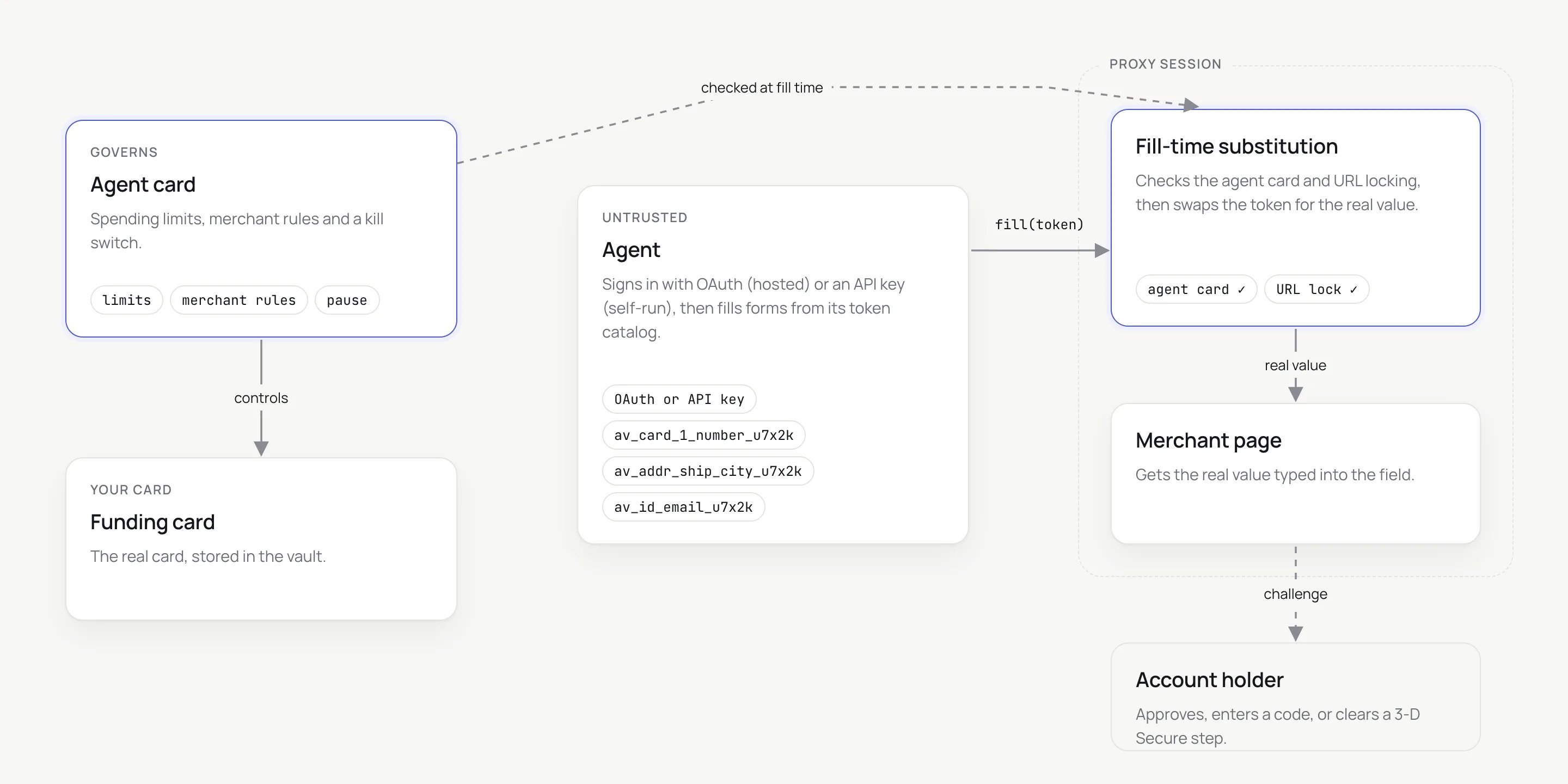
How the pieces fit together.
Mock token
A mock token stands in for a real value, such asav_card_1_number_u7x2k or
av_login_github_password_u7x2k. Typed anywhere outside the proxy, it is a
literal string: the checkout fails and nothing real is exposed. Tokens do not
expire, and changing a password does not change its token. Full format:
Token grammar.
Token catalog
The catalog lists every token an API key may use, plus non-secret details for choosing between them: card brand, last four digits, expiry, and the sites each card or login applies to. Everything sensitive in it is a token, so it is safe to give to any agent. Fetch it withget_token_catalog, listTokens() or
GET /v1/tokens. Full shape: Token catalog.
API key
An agent that runs the MCP server itself, or uses the SDK, acts for your account with an API key. Keys start withav_, are shown once, and can be limited to
specific cards and logins, so one agent can get less than another. A key that
tries another account’s tokens three times in five minutes is revoked
automatically. See API keys.
An agent on the hosted MCP server has no API key. It signs in with OAuth, and
that sign-in becomes a connection you limit the same way, on Connected apps.
See Connected apps.
Proxy session
The agent sends commands such as “open this page” or “fill this field” to the Agent Vault proxy over a WebSocket. The browser, its tabs and cookies belong to one proxy session, which ends after 15 minutes idle or 60 minutes in total. After that the agent starts a new session with a fresh browser. See Sessions and timeouts.Fill-time substitution
A token becomes a real value only inside the proxy’s browser, as it is typed into the field. Every rule is checked at that moment: the site, the account, the key’s scope, your merchant rules, whether the site is an authorized destination, your limits and your approval threshold. If any check fails, nothing is typed and the agent gets an error code. A failure after typing starts, such asfill_rejected, can leave part or all of the value on the page. The full
decision is on How it works.
URL locking
A login works only on its registered website, its subdomains, and any extra websites you added, so an agent cannot be tricked into typing your password on a fake site. A card works wherever its agent cards allow, which is any site unless you set merchant rules, and only on an authorized destination. See URL locking.Funding card and agent card
The funding card is the real card you added and the one the merchant charges. An agent card is a set of rules on top of it: spending limits, merchant rules, an approval threshold, a webhook and a pause switch. It has no card number. A funding card with no agent card has no spending caps or merchant rules. Only your plan’s payment quota still counts its fills. Your first card gets a starter one automatically, but any card you add after it does not: click Add limits on it. See Agent cards.What happens when several agent cards govern one funding card?
What happens when several agent cards govern one funding card?
The fill goes ahead if at least one active agent card on that funding card
allows the merchant. Then the limits of every agent card on it that allows the
merchant and is active or stopped at its limit apply. One you paused yourself
lends no limits.
Challenge and handoff
A challenge is a step meant for a person: a 3-D Secure bank prompt, a one-time code sent to you, or a CAPTCHA. The proxy detects these and never solves them. A handoff shows you the agent’s live page so you complete the step, while the agent’s page commands are blocked. One exception: an authenticator-app step on a login with a stored TOTP secret, which the agent fills with that login’stotp token. See Handle challenges.
Checkout recipe
A recipe is a public JSON description of how a platform or store’s checkout works: how to recognize it, where the card goes, and known dead ends. Each carries a status, fromverified (a real purchase, proven by a receipt) to dead-end (no
unattended checkout is possible, with the reason). See
Checkout recipe registry.
Next: How it works to follow one checkout from start to finish.